Interview with Giacomo Fiore & Evan Hardy
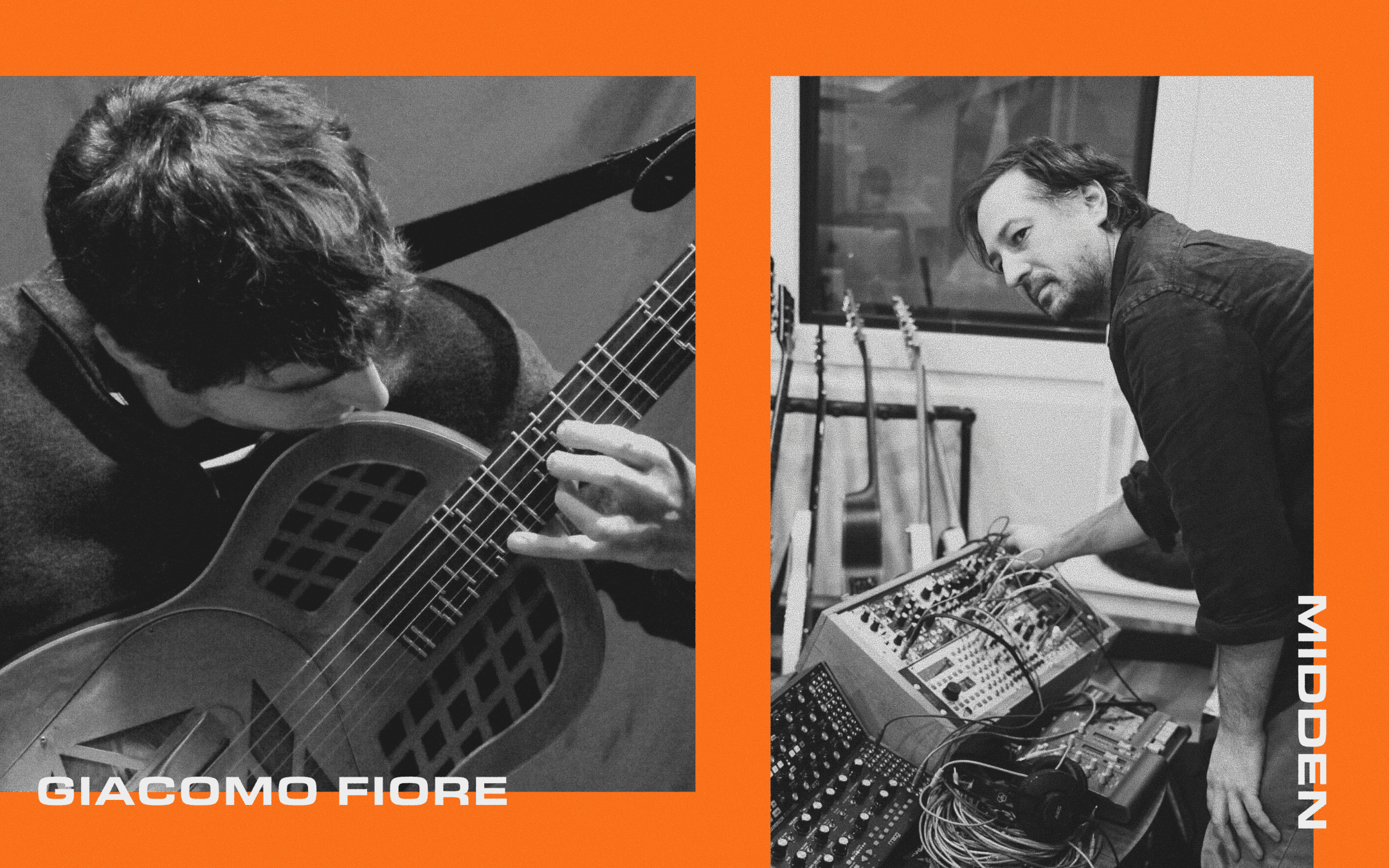
Giacomo Fiore and Evan Hardy talk through the evolving setup behind their work: fretless guitars, the Landscape Ferrous, varispeed tape loops, and modular buffers flickering in and out of sync.
Ben: Walk us through your setups.
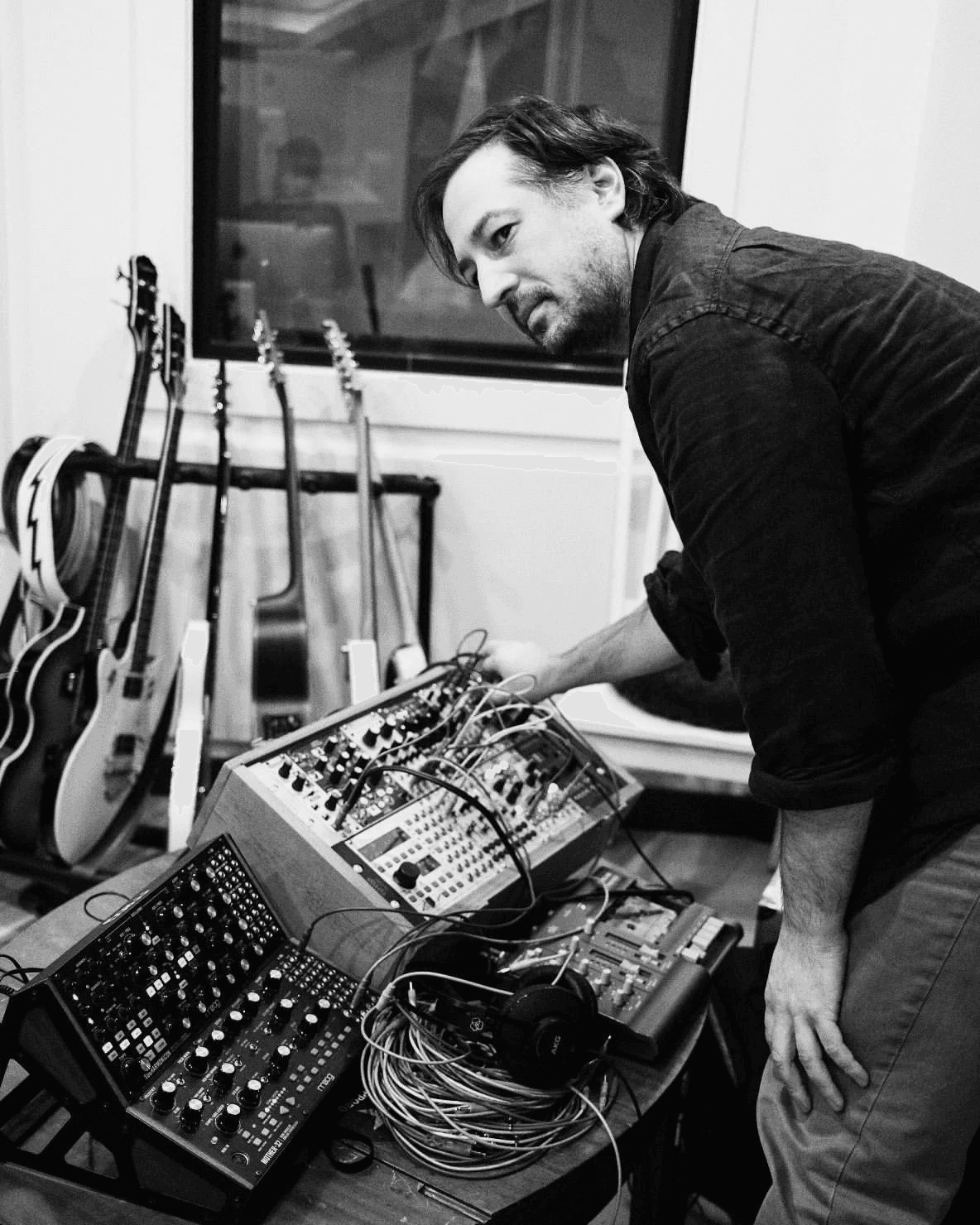
Evan: I’m playing guitar through a pretty simple pedal chain, into my DAW. The signal goes volume pedal, overdrive, loop pedal, tremolo, reverb and delay. I’m also using the Landscape Ferrous, the little magnetic string resonator, which both of us have been using at different points.
On the other side I’ve got a reel-to-reel machine with a varispeed mod. That runs into a modular synth that’s set up for looping and triggering. The tape plays into the synth, the synth grabs it into a loop buffer, and there are a bunch of shared buffers running at different speeds. Those are being triggered in a sort of musically random way through low-pass gates, which gives you a pulsy, plucky texture I can shape with envelope and length.
There’s also another oscillator I’m tuning by hand to add higher, more piercing sounds. All of that runs through delay and compression into my DAW. There’s a polysynth, a Trigon 6 SE desktop, patched in as well.
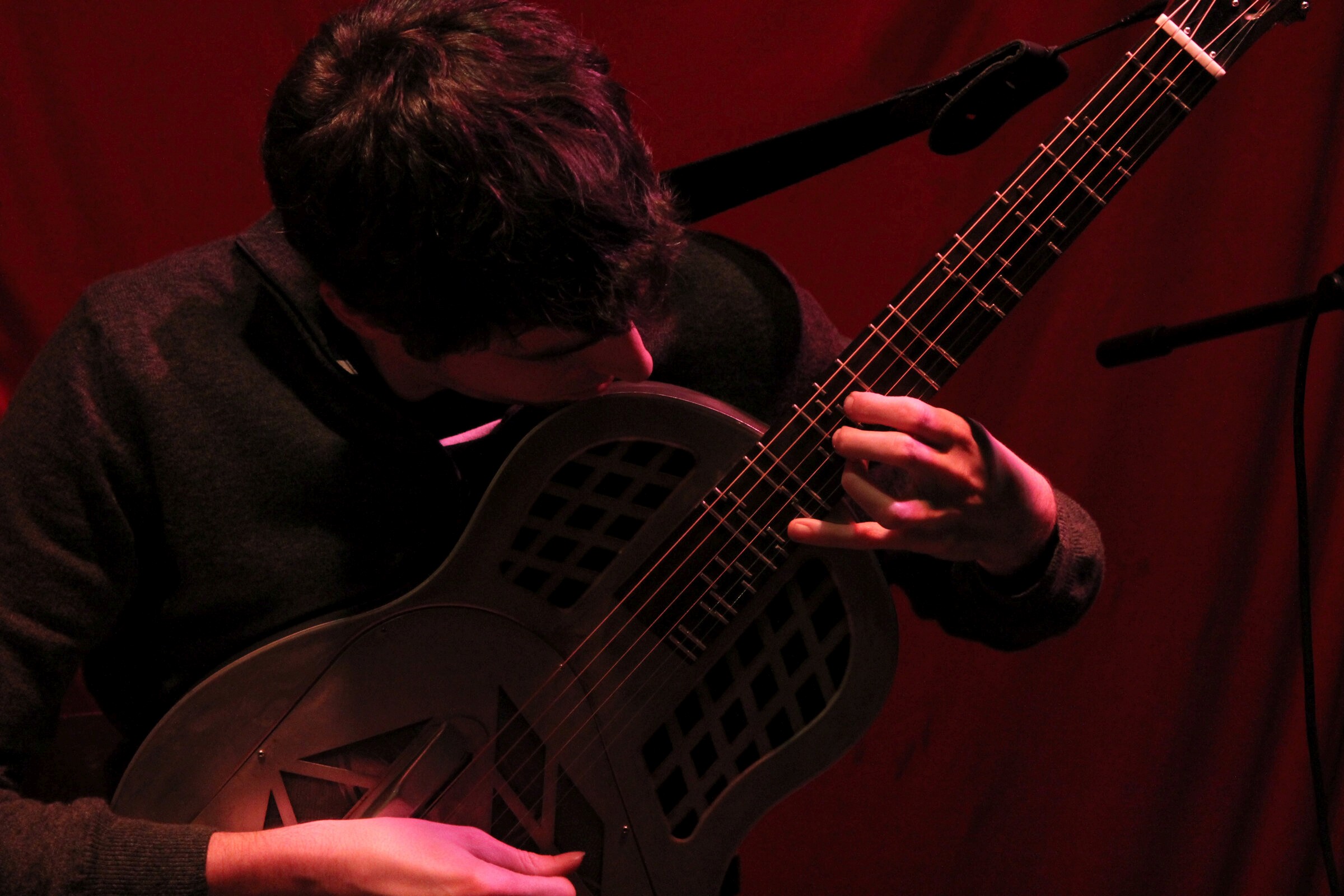
Giacomo: I’m playing fretless guitar into an amp simulator, which then goes straight into my Eurorack system.
On an aux send from the guitar I have three loopers running in parallel. One behaves like a tape loop, where the loop length is however long I record. The other two are variable-length delay lines. I can control how much signal feeds into them, which decides whether they’re recording or just playing back, and I can change their length on the fly.
Everything feeds into a parallel reverb. Because all the loopers and the reverb are on sends, I can create different feedback paths between them and push things into very short, almost self-oscillating delays. The core of it is a 4MS Dual Looping Delay. That module is basically the brain of my whole aesthetic. One module, one obsession.
Ben: I definitely heard moments where I couldn’t tell if you’d just sampled yourself or were playing live on top of it.
Giacomo: That’s intentional. I’m sampling myself pretty heavily, but I’m also playing a lot of self-similar material on purpose. I like having asynchronous loops running, where it’s not immediately obvious what’s looping and what’s me echoing the loop, or echoing something I hear Evan do. The blur is the point.
Finding a shared language
Ben: How did you both explore music together and find a shared perspective?
Giacomo: Mostly we just played. We’d jam, then step back and listen to what had happened, and talk about it a bit. I don’t think we ever gave each other “homework” or anything structured. It felt pretty easy. I think we’re both tuned into listening, into reacting to what the other person is doing.
For me it’s about reflecting on what you’re playing while you’re hearing the whole thing, and trying not to get lost in your own sound. You want to shape the larger thing as it’s happening. That’s basically the creative brief.
Sam: Is improvisation like this a comfortable space for you both? You’ve both worked in ensembles and different performance settings.
Evan: When I first started playing music as a kid it was in jazz band. I was never a great trumpet player, but I loved improvising. Later, in bands, the free-form jam part of writing songs was always my favorite part. So I’m comfortable with improvisation, but it had been a while since I’d done it regularly, and I’d never done it over the computer.
Not seeing the person you’re improvising with was an adjustment. At the beginning I honestly had no idea what was going on for the first couple of sessions. But it’s been fun and really rewarding. I’ve had to focus way more on listening instead of visual cues, leaving space, and pulling back if Giacomo is doing something interesting, and trusting he’s doing the same.
Giacomo: It can get confusing in a good way. Things are layered enough that it’s not always clear who’s doing what.
I also try not to stay entirely on familiar ground in a project like this. I have gestures I return to, and we have a sense of a few places we can land, but there’s no map. That’s what’s interesting. The stakes are low, in the best way. It feels safe to go into uncharted territory.
Ben: I really like that you’re embracing this as a space to let go and take risks. Sam and I have been doing this kind of remote improvising for over a year, and you start to just live in the sound where it becomes less about “my” part and “your” part and more about the totality. You get this sense of your sounds melting together.
Giacomo: Early on we talked about cross-feeding audio more directly, sending parts of each other’s signals back and forth. But after some wrestling with Cleanfeed and getting the basic routing stable, we ended up in this parallel workflow. The cross-feeding now happens more in the way we listen and respond than in literal signal routing.
Technically we could have done more, but at some point it felt like we were already making a lot of sound and had enough tools on the table. It became about using what we had rather than chasing another layer of complexity.
Guitars, tuning, and the Landscape Ferrous
Sam: The sound you’ve arrived at is very wiry and string-forward. It feels like the strings are a main character. Was that an intentional place to land, or did you just drift there?
Evan: The first time we tried to practice were just talking about what we were doing and both held up the Landscape Ferrous. That became one of the shared tools.
As much as I keep trying to get away from guitar, I often end up back on it. Bass is the instrument I’ve played the most in bands, but I do like playing guitar, and it made sense here.
Giacomo: I don’t do much that isn’t guitar in some form, so my way of creating contrast was going fretless and tuning lower. I’m tuned to the equivalent of standard guitar but down in C, so it gives us a different range and a bit of separation.
Sam: Are you doing anything specific with tuning systems, just intonation, anything like that?
Giacomo: We didn’t agree on a formal system. I’ll sometimes tune things justly, but not in a strict or dogmatic way. It’s pretty fluid.
Evan: I’m just in drop D. At home I’ve mostly been playing in open C, but for this I stayed in drop D. I’m rarely playing clear notes anyway. Most of what you hear from me is the Ferrous looping the strings, and then I’ll use the volume pedal to swell in a note here or there.
Giacomo: I also use a single alligator clip on a string, just to get these tiny mechanical noises. That’s probably the “stringy” sound you’re hearing in my playing. With fuzz it gets very explosive.
Ben: It really does sound like a micro looping pedal, except it’s mechanical, which I love.
Short delays, feedback
Sam: You mentioned that really short delays are central to your sound, Giacomo. With short delay times you can get these cycling, almost pitched effects. How did you find that technique, and what are you chasing with it?
Giacomo: I actually picked it up from the 4MS manual, which talks about running the module at very short delay times. Because it’s tap-tempo, the fastest tap becomes your base, and dividing that gives you these extremely short delays. The goal is to find a resonant point where the delay time and feedback excite whatever you feed in. I also let the two delay lines influence each other, using triggers to flip reverse and hold, which changes how the feedback behaves. At those speeds you get rich harmonics, and if you switch back to a long delay, you suddenly hear a frozen slice of the last few seconds. I don’t always know what’s going to come out, which is what makes it interesting.
To zoom out a bit, I see this as part of the same continuum as granular synthesis, which I also love. Long repeats versus short repeats, long grains of sound versus short ones, and the ways you move between them. That spectrum is central to what draws me into this way of working.
Sam: Thanks, both of you. This was really generous and helpful, and it’s been fun getting a window into how you’re approaching this. Can’t wait to hear the set.
You can hear Giacomo and Evan perform live on December 6, 2025, via Bandcamp. The set streams at 12:00 PM Pacific / 3:00 PM Eastern / 9:00 PM Berlin.
Mentioned Artists
Mentioned Residencies
Collected Works
Join our newsletter for upcoming sessions and releases, curated listening lists, and subscriber-exclusive recommendations.