Two Friends on a Long, Slow River
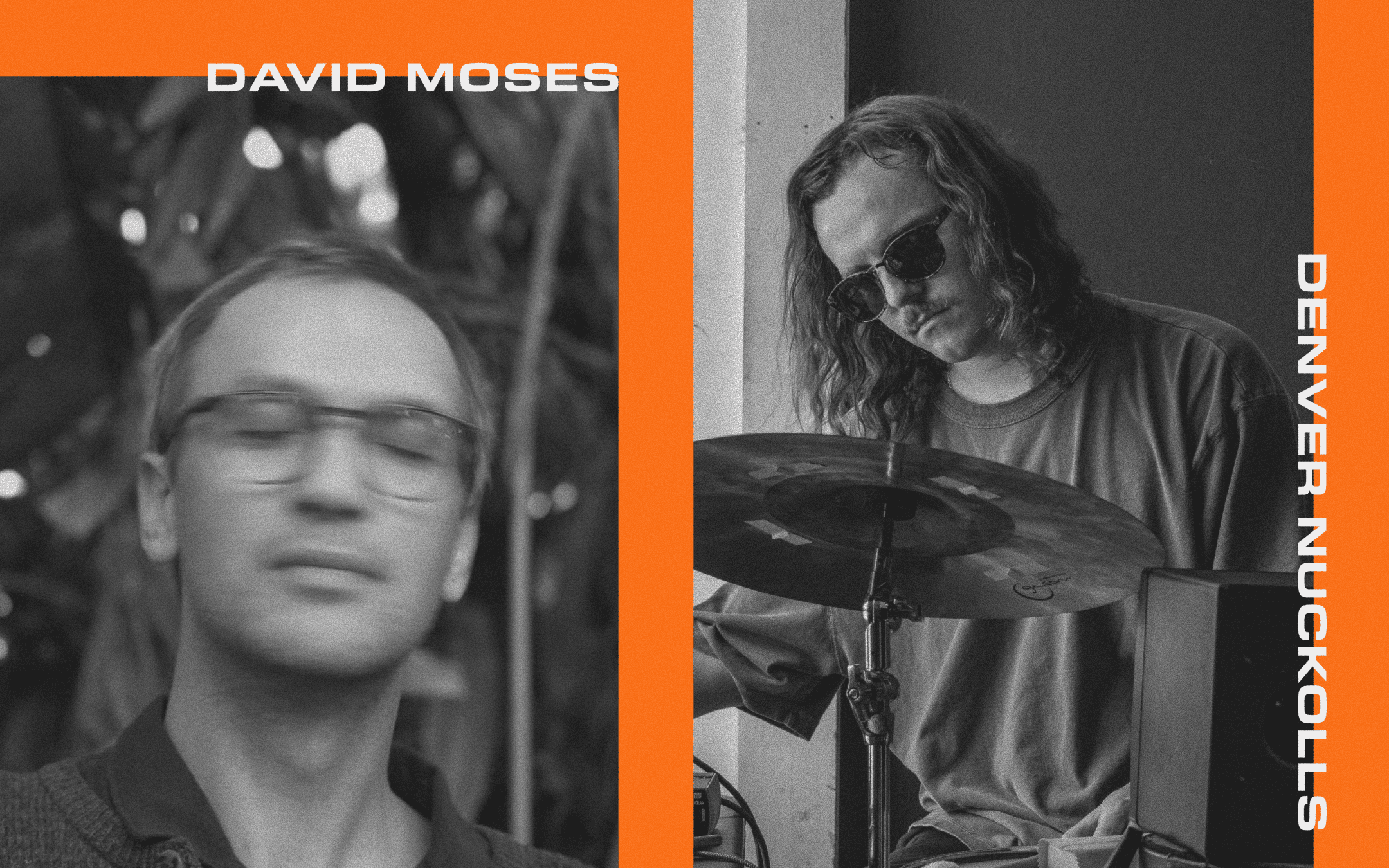
David Moses and Denver Nuckolls’ performance illuminated time with the layered improvisation of percussion, breath-controlled synthesizers, and electronics composed through shared attention and trust.
In conversation after their session, they reflected on the serendipity of two strangers becoming friends and collaborators, and how their local music scenes primed them for this remote yet deeply interconnected process.
Sam: As I listened, I felt as though I were drifting along a languid waterway, with so many different landscapes passing by. It reminded me of A Large Slow River by Janet Cardiff and George Bures Miller. It’s an audio work meant to be listened to on site. As you listen to the narration, there’s an overlap between what’s happening in the physical space and what you’re hearing recorded. You move through a series of emotions. There’s darkness, light, beauty, pain, and it’s all in constant motion. One of the central elements of the piece is water, and listening to you both expertly craft sound tonight felt very river-like.
Ben: I can join you on that river as you describe it. I just want to say that the final movement, especially the last ten minutes, was incredibly moving. There were moments that felt almost hymn-like, as if they were drawing from something deep within my own personal history. I was genuinely moved in a way I haven’t been yet during these live performances. Thank you for creating that experience.
Sam: To start us off, would you mind walking us through your setup?
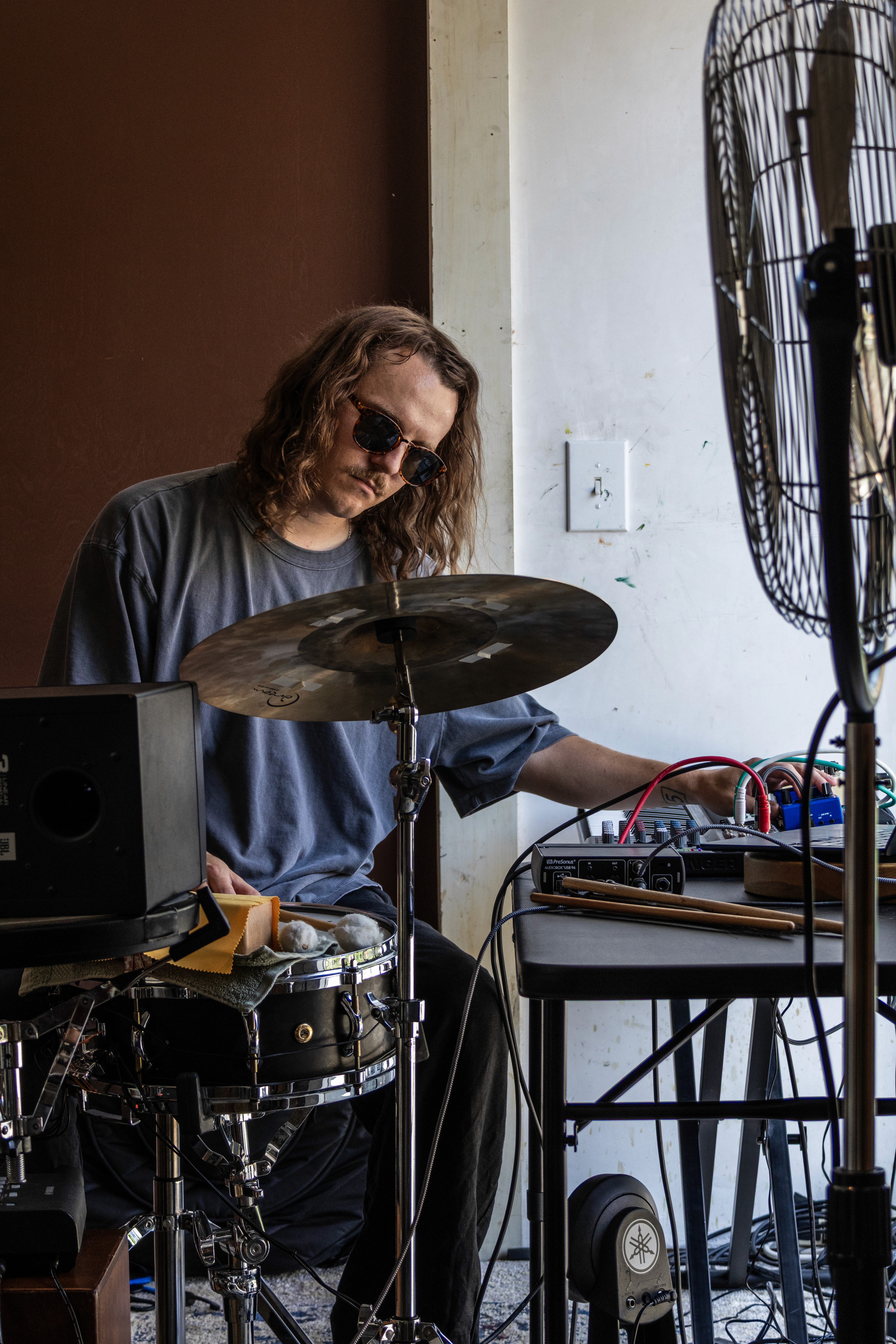
Denver: My setup is arranged at about a ninety-degree angle. On one side I have percussion, and on the other I have keyboards and electronics. For percussion, I’m using a snare drum and a cymbal. I have a kick pedal attached to a kick trigger pad from a basic electronic practice drum kit. The kick pedal outputs a standard electronic kick sound through the drum module.
I also have quarter-inch cables zip-tied to the snare drum. Those run into the same electronic drum module. Because they’re just loose cables making contact, they create these glitchy, repeated trigger sounds. It’s very unpredictable and textural.
On the electronics side, I’m using a Casio ToneBank CT-670. It belonged to my uncle, and we found it in the house. When I saw that it had envelope controls, I immediately wanted to explore it. It felt really good to use it tonight.
That keyboard runs into an Alesis Wedge outboard reverb from 1996, which is brand new to me as of last weekend. I’m still learning it. From there, everything goes into a loop pedal where I’m looping, reversing, and working with tempo. Then it all runs into a simple four-input Behringer mixer. That mixer not only handles my signal but also lets me push the gain to get some of those vinyl-like crackle textures.
It’s not a very complex setup, especially compared to David’s, but I try to get as much out of each tool as I can. For the percussion mics, I’m using two Shure SM57s. They’re workhorses, classics. You can’t go wrong with an SM57.
And then I have my bag of implements, sticks, mallets, brushes, chopsticks, snare wires, all of that.
Sam: Excellent. You got such a fascinating range of sounds out of that equipment.
Denver: Thank you. I spend a lot of time exploring those sounds, so I’m glad it came through.
Sam: What about you, David?
David: I have a few things going on. One of the more direct elements is a Sequential Prophet Rev2 with patches I’ve made. The more harmonically dense, jazzy sections came from a patch on the Prophet that layers modal chords with a sub-bass tone. I really love its stacking feature, where you can run two sounds simultaneously.
I’m also using an Arturia MicroFreak. A lot of the skittering, granular textures came from that, especially using the chords engine derived from Mutable Instruments Plaits.
I also play an Akai EWI1000 with the EWV2000 synth module. It’s actually the first EWI, released in 1986. It’s essentially a two-oscillator analog synthesizer with a beautiful filter. What really drew me to it was the expressivity. I’d spent years trying to make synths feel more expressive, and breath control through the EWI was an immediate revelation. I’ve only been using it since this past summer, but it’s completely changed how I approach playing.
Then I have two Monome Norns units. Monome is a small, open-source company based in upstate New York. Norns is a small music computer with community-built scripts. Tonight I was using a script called mlre, where the “e” stands for extended.
It’s essentially a six-track live resampling system. I can loop incoming audio, control pitch, and sequence gestures using a Monome Grid controller. What you heard a lot tonight was me capturing Denver’s percussion and keyboard playing and processing it in real time. It has a reel-to-reel feel, with this slewing effect between layers. It’s live resampling, but with a very tactile, time-based character.
Everything runs through a small mixer so I can blend and manage those layers.
Sam: That’s great. Thank you both for sharing. Is there any particular piece of gear that has really shaped the way you play?
Denver: Honestly, it’s the zip-tied quarter-inch cables. I originally took apart an electronic drum kit because it was taking up too much space. While doing that, I accidentally triggered one of those glitchy sounds. I’d only experienced that kind of thing before by plugging a loose cable into a guitar amp, which just creates noise. I didn’t realize the drum module would respond with repeated triggering.
What’s interesting is that the cables are attached in a way that isn’t very accessible. I have to reach under the rim of the snare to interact with them. That’s forced me to rethink how I play and how much activity or texture I introduce. Most of my percussion playing is fairly traditional, so this has pushed me into new territory, especially blending acoustic and electronic sound without relying on heavy live processing.
It’s been a really valuable challenge. And getting to know the Casio has been just as important. When I get a new instrument, I try to commit to it and really learn what it can do, rather than chasing the next thing. Surprisingly, that basic Yamaha drum module has been one of the most influential tools for me recently.
Sam: It’s amazing how simple discoveries can reshape someone’s musical language.
Denver: Yeah, I hope I can keep extending it. It’s been a lot of fun.
Sam: What about you, David?
David: It’s definitely the Norns. It’s become central to my practice. Live resampling other musicians and myself has fundamentally changed how I think about form and time. I can create asynchronous loops or tightly locked ones, and the textures that emerge feel endlessly inspiring.
Being able to grab snippets of Denver’s playing and transform them felt like creating an auxiliary percussion layer. The tools themselves are actually quite simple, time, pitch, panning, filtering, but they’re assembled in a way that’s deeply musical. These techniques go back to the earliest days of electronic music, but they’re combined here in a very accessible, expressive system.
Beyond that, the community ethos around Monome and Norns is incredibly inspiring. There are so many scripts, and it constantly feels like there’s more to explore.
Ben: David, I’d love to hear about how the two of you went from complete strangers to collaborators, and honestly, to friends. What were some of the key moments that shaped what we heard tonight?
David: When you first framed this as a residency, it really felt like one. It wasn’t just about making music, but about spending time together. We had around five or six sessions, and right away we found kinship in our musical taste. We both love Sam Gendel, which was an immediate connection.
We shared playlists, talked before and after rehearsals, and shared our experiences as musicians in our respective communities. From the very first moments of playing together, it felt special. That sense of connection quickly turned into friendship, and it really fueled the music.
Ben: Anything you want to add, Denver?
Denver: I completely agree. I often enter collaborations thinking about taste, but usually that just leads to conversations and then people go their separate ways. This felt different immediately. Beyond Sam Gendel, we kept discovering shared references, especially within the LA scene, which I’ve followed for years.
Every artist I mentioned, David already knew personally. It was exciting to nerd out about his world. At the same time, we shared enthusiasm for artists like Oneohtrix Point Never and the Boston scene. That overlap felt really special.
Beyond the music, it was meaningful to get to know David as a person, meet his partner, hear about his life. That’s what made this feel like a residency rather than just a gig. It deepened the collaboration in a real way, and that includes everyone involved with Exposure Therapy as well.
Ben: You’ve both talked a lot about community and local scenes. I’m curious how those scenes influenced this collaboration, especially since you were working remotely. What did you bring with you from Boston and Los Angeles?
Denver: In Boston, my life is split between band work and improvised music. Bands there rely heavily on community for gear, spaces, and support. The experimental side of the scene is heavily rooted in free improvisation, often acoustic. The New England Conservatory has a strong improvisation program, and many musicians circulate between Boston, Providence, and New York.
I approached this collaboration as I would an acoustic improvisation setting, even when electronics were involved. That mindset really clicked with David. The scene here values adaptability and openness, whether you’re playing a basement show or a museum. That ethos definitely shaped how I played.
David: I feel incredibly fortunate to be in Los Angeles, especially East LA. There’s a vibrant overlap of experimental jazz, ambient music, and improvisation. After the pandemic, I was deeply influenced by outdoor shows run by Leaving Records in Highland Park. It was a crash course in how open and expansive experimentation could be.
One venue that really encapsulates this is Solarc, a musician-run brewery near Glendale, CA. You’ll see conservatory-trained musicians playing alongside DIY artists with no hierarchy or judgment; that openness is everywhere here. That environment showed me that you can follow what you’re drawn to and people will show up, and the sense of community transformed my music from a private practice into something deeply collaborative, which led directly to experiences like this one.
Sam: Thank you both so much for sharing. You both brought eclecticism and a real freedom to explore. Letting go of perfection and focusing on connection feels central to why Exposure Therapy exists. Thank you for your music and for this conversation.
Mentioned Artists
Mentioned Residencies
Mentioned Albums
Collected Works
Join our newsletter for upcoming sessions and releases, curated listening lists, and subscriber-exclusive recommendations.