In a Floating World
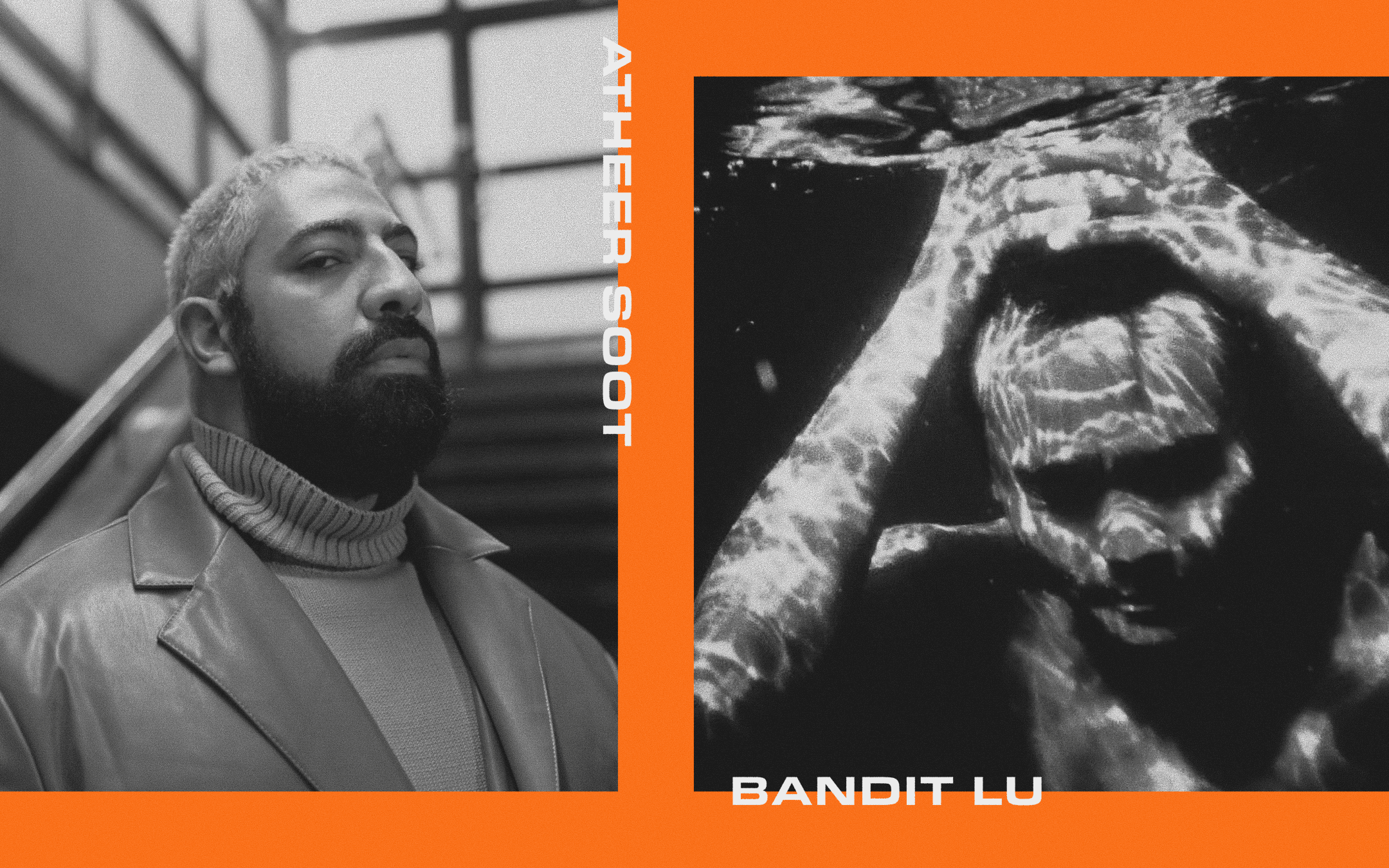
Upon an ethereal foundation of field recordings, piano loops, and slow-moving drones, Atheer Soot and Bandit Lu build a habitable atmosphere that feels suspended, weightless, and in abundant motion.
After their live performance, we sat down with the artists to talk through the ideas and processes shaping their collaboration. The brief conversation highlights technical choices and intuitive decisions, touching on approach, concept, and the way that sound can feel both still and constantly in flux.
Ben: That was Atheer Soot and Bandit Lu live on Exposure Therapy.
Sam: Gorgeous music. Melodic, soothing, calming.
Ben: Words like celestial and ethereal came to mind. I often felt weightless listening to it. There was also a mysterious quality. With the field recordings of water and the instrumentation, it felt like there was some kind of Eden just around the corner that I could never quite reach. Every time I turned that corner, there was another one. It felt like being pulled through a kind of labyrinth.
Sam: That’s a beautiful perception. It reminds me of zen gardens, where you’re sitting and staring at a scene that’s still, but constantly changing in how you perceive it, an ongoing adjustment in how you experience the sound and even time itself.
Ben: Yeah, I think that’s spot on. The moment you think you understand their world, it shifts and beckons you somewhere else.
Sam: So we’re going to have a brief discussion with Andy and Moe. Andy, can you walk us through your setup?
Andy: I use a lot of field recordings, and for this set I kept things pretty basic. I used my modular synth with oscillators, and looping devices. I’m really into microtonal work, so a lot of it comes from slowly adjusting the coarse tuning on the oscillators to create drones. That’s all backed by piano loops I’ve developed, which really set the tone. Then it’s about mixing that with Moe’s soundscapes and drones. I think our styles really melt together.
Sam: “Melt together” is a great way to put it.
Ben: Moe, do you want to tell us about your setup?
Moe: For this set, I also kept it pretty basic. I used pre-recorded piano loops and guitar loops, then processed them through Ableton Live. I built an instrument rack for generating drones and sequencing some melody.
Conceptually, I was thinking about interfering with Andy’s world, jumping in and out of it. That helped me structure where I should begin and where I should end. I really enjoyed Andy’s field recordings and the piano loops he created, which made it easier for me to ease my way in and out of the set.
Ben: The balance felt very thoughtful; nothing felt overwhelming or like it lingered too long. There was a lot of care and precision in how the two of you interacted.
I’d love to hear more about your process. Moe, can you talk about how you collaborated, how you found your sound, and how you prepared for this set?
Moe: It really started with Andy sending me some ideas and samples. He’d say, “I’m thinking about this,” or “I’m exploring this direction.” I felt like his style aligned really well with mine, so it wasn’t hard to find my place in it.
I told him the examples were great and suggested we just jam and see where the journey would take us. We threw ideas around, and gradually found our sound.
Ben: Andy, how much of the performance was improvised versus prepared?
Andy: We definitely set out a bit of a game plan. With experimental ambient sets, I think it’s helpful to have a loose roadmap. Not rigid, but an idea of the story, the mood, even the keys we’re working in.
We played with some progressions and built around them. I’d say it was about half prepared and half pure improvisation. For me, having some prepared material helps anchor me in the performance and gives me something solid to share with the audience. From there, I can move around it more freely.
Sam: That leads nicely into the next question. Andy, how did collaboration affect your process for this performance?
Andy: I spent a lot of time listening to Moe’s work beforehand, and we’re very aligned in terms of soundscapes and overall approach. We both tend to start with loops that set the tone, then build on top of each other. It’s about reinforcing and helping the piece transition from section to section. Nothing too complicated, but very intentional.
Sam: Moe, anything you’d like to add?
Moe: It was a great opportunity to collaborate with Andy. I really admire his work. When he suggested keeping the field recordings running underneath everything, acting as a constant texture we could enter and exit, that really stuck with me.
The idea of the field recording as a kind of gate was really interesting. It gave me more to play with conceptually.
Sam: I love that idea of a gate. It reminds me of the Japanese concept of ukiyo-e, the floating world. That’s how this felt to me, like moving back and forth between different layers or atmospheres.
Ben: That’s a great visual for the whole experience.
Sam: Thank you both for joining us. That was Moe Mustafa of Atheer Soot and Andy of Bandit Lu.
Ben: Thanks so much for the performance, and for sticking around to talk with us.
Mentioned Residencies
Mentioned Albums
Collected Works
Join our newsletter for upcoming sessions and releases, curated listening lists, and subscriber-exclusive recommendations.