It’s Just in the Air

Klinke and Torres find themselves less concerned with direction than with attention, allowing curiosity to guide each turn in the conversation.
Prior to their live session for Exposure Therapy, host Ben Domanico-Huh discusses process, exploration, and the evolving musical partnership between Vancouver-based Alexander Klinke and Troy, New York’s Sam Torres. Blending the acoustic resonance of the viola caipira with the experimental textures of the Buchla Music Easel and saxophone, Klinke and Torres discuss the challenges and rewards of remote, improvisational collaboration, ultimately revealing a natural musical kinship that thrives without visual cues.
Ben Domanico-Huh
That was Alexander Klinke from Vancouver, Canada, and Sam Torres from Troy, New York, playing some of their set for us that they're preparing for Exposure Therapy. Thank you both for that wonderful experience. You both have incredible chemistry together that seems to have developed over a very short amount of time.
To start off, I'd love to learn a little more about what you're both playing today. Alex, you can start.
Alexadre Klinke
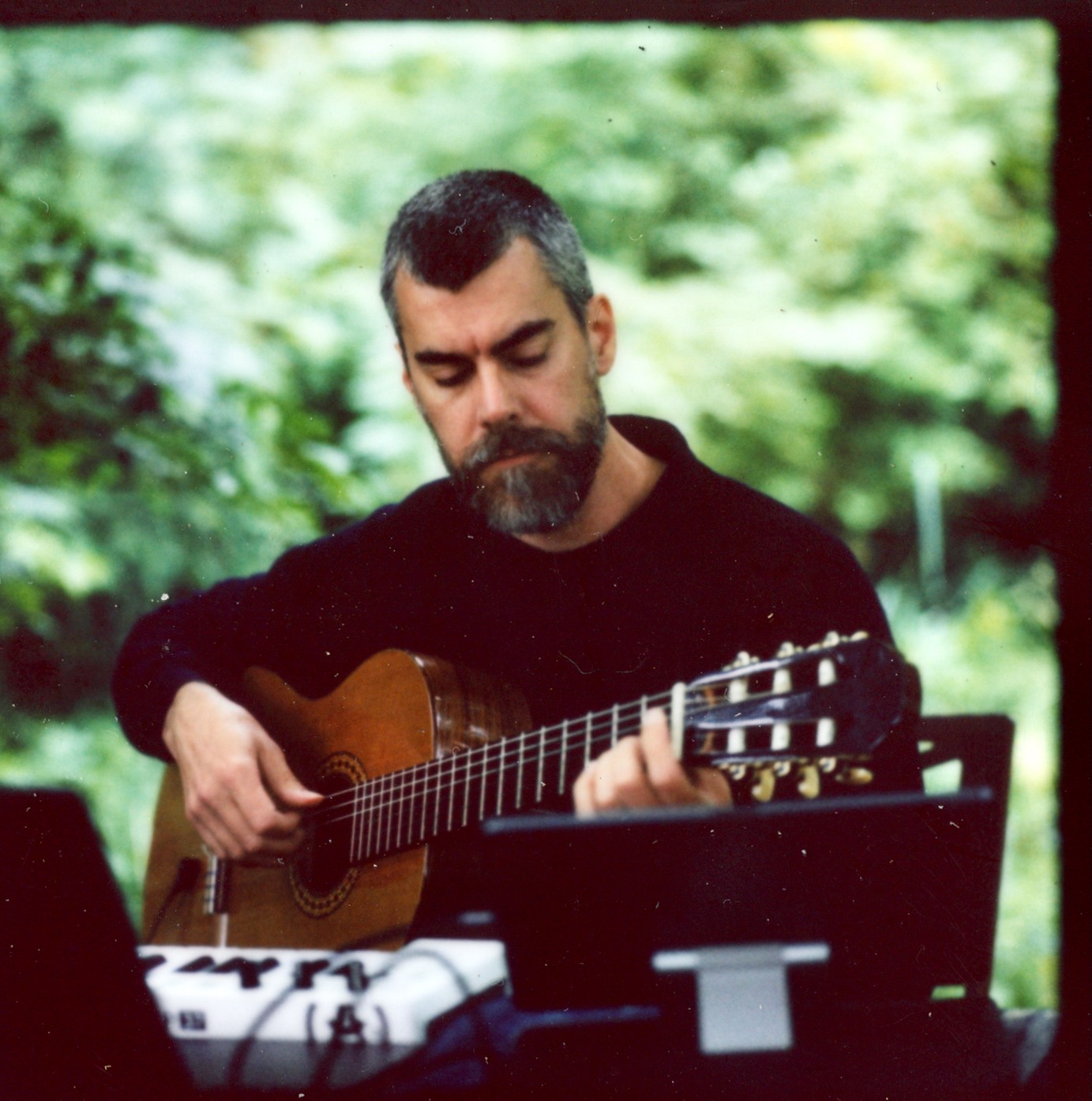
I was playing this 10 string guitar from Brazil. It's called a viola caipira, not to be confused with the classical viola. It looks like a small guitar with 10 strings and is usually played in an open tuning. This one is in D major.
I'm also planning to use a nylon string guitar with some guitar pedals. Everything is fed into Ableton Live. I have some extra effects already set up in a template in Ableton, along with a small keyboard MIDI controller and an APC40 where I can twist knobs and shape effects. That's my setup for now.
Sam Torres
I'm playing my saxophone with an internal pickup, which goes into a few effects pedals. I've got an octave shifter, my H90, and a reverb; that's one audio stream.
I also have a Buchla Music Easel that's going into a looper; that's the other stream. There aren't any additional effects on the Buchla. It has a physical spring reverb inside it that does its own weird things. Then it goes into a stereo looper, and that's it.
Ben
The Buchla was such a unique sonic voice in everything you were both doing.
Sam
It's definitely got its own sound that I just want to bathe in forever.
Alex
It's a pretty big sound. The Buchla just sounds large.
Ben
I like that you said "bathe in it" because I did feel like I was bathing in that sound. The use of field recordings at the beginning, and what I thought were manipulated tape sound effects on your guitar, Alex, combined to create this subaqueous, watery feeling. I loved it so much.
Like I said at the beginning, it seems like there's such a great musical kinship between you both. It feels effortless, and you haven't been playing together for very long. Walk me through those first few practices, how you connected on a sound or way of playing, how things have evolved so far, and maybe how you think they'll continue to evolve.
Sam
Honestly, we just jumped in and saw what happened.
What you just heard was only our third time playing together. During the first and second rehearsals, we were both using pretty different setups. I used to have a completely software based setup, and now I'm working entirely with pedals, the analog synth, and the saxophone. There's no computer involved anymore.
I was still figuring that out during our first rehearsal, so there were definitely some creative constraints. I enjoy that kind of thing, though. Alex and I talked about those challenges quite a bit during our last practice.
I think during the second rehearsal I had more gear than I did the first time, and Alex had simplified his setup. But we still found our way.
Alex
Yeah. For me, the difference was that I was playing bass guitar and electric guitar during the first rehearsal, which has been my main setup recently.
Then during the last rehearsal I switched to the acoustic instruments, and that's all I used. Something happened there that I really liked. The viola caipira works really well with your saxophone and the more electronic elements.
Sam
It's a really nice contrasting sound.
Alex
Totally.
Speaking about the musical aspects of this collaboration, I think both Sam and I having backgrounds in jazz and improvisation helps a lot. We didn't have a script. We just started playing together and quickly fell into these musical conversations pretty effortlessly.
I like keeping things open and figuring out what's happening at the moment. I think that's a good strategy. I don't think we should deviate from that too much.
Sam
Totally. I agree.
Ben
I was going to ask whether, as you're getting closer to the live session, you've been thinking about staying fully improvised or introducing movements, scoring, or anything more structured.
Sam
Not really. It's still pretty free and open, which I like.
We talked about how we're both usually solo performers, and figuring out how to improvise together has been an interesting challenge for each of us.
Although I was thinking about last rehearsal when you told me I should start and you'd come in afterward. I played for about five minutes and thought, "Wow, Alex is being really restrained today."
Then it turned out you'd muted the wrong thing.
Alex
Yeah. I was playing and having a blast. No one was listening.
Sam
I'm glad you were having a good time.
Alex
It's interesting because we've been recording the rehearsals. I listened back to the first one, though not the second yet.
I've done this before with other collaborations where you end up with material you can revisit and learn from. But honestly, I'm happy to show up on the day with no plan and see what happens.
Sam
Me too.
I think we're also very aligned tonally and texturally. The pacing feels natural too. It feels like we both sense when the other person is starting to shift something.
Ben
That's why the first thing on my mind was how in sync you both are without visual cues or verbal communication. You're just listening.
It's really special to witness. There's also this interesting contrast because improvising remotely like this is such a vulnerable and risky way to play. You're not in the same room. You can't see each other.
But the music itself is so lovely and nuanced. It's like soft courage. That's the phrase that comes to mind. It's a very brave way to make music, but the result feels gentle. I just like that. It's very cool.
Sam
I appreciate that.
Ben
And I fully support keeping things as loose and open as you want. There's no right or wrong way to approach the live set. The whole point is to see what happens. It's live. It doesn't need to be perfect, and honestly it shouldn't be.
Alex
Exactly.
Being open to mistakes and a few wrong notes is what makes this possible. If you become overly precious about what you're playing, I think it falls apart.
I'm always open to whatever comes. I like embracing the weird things that happen and treating them as opportunities to go in a different direction.
Sam
That's one of the nice things about performing live. You don't really get the chance to second guess yourself.
Alex
It's also very different playing without visual cues. This is the first time I've done something like this.
When you're improvising with someone in the same room, you can look at each other and pick up visual signals about where things are headed. Here, it's completely ethereal. It's just in the air.
There's a special quality to playing this way that's very different from anything I've done before.
Ben
I'm glad you're both finding that.
That was really the big realization for Sam and me when we started making music this way. It's not the same as being in the same room, but that doesn't mean it's worse. It's just different.
One thing you might explore, since you already seem so comfortable improvising together and you already sound like you have such a good congealed sound, is finding ways to surprise each other. Maybe there are ways to introduce playful curveballs into the process. You both have plenty of sound making gadgets at your disposal. It could be interesting to see what happens.
Alex
That's interesting.
It reminds me of an improvisation group I joined years ago in Vancouver. There were maybe twelve people rotating through different combinations.
Sometimes you'd have this really quiet, gentle section, and then the next group would come in blasting their instruments and making an enormous amount of noise.
I loved those contrasts. It's not something I naturally do. I tend to stay within a particular space. But what you're describing reminds me of those abrupt shifts into completely different territory.
It's something worth remembering.
Ben
I was listening to recordings from Giacomo and Evan's rehearsals, and they were very improvisational too.
At one point they were discussing how to start, and Giacomo said, "Let's just start really loud. I don't think they're going to expect that."
That was basically the entirety of their planning.
Should we start soft or loud?
Sam
That's great.
Ben
Well, thank you both for giving us a glimpse into how everything is coming together.
It sounds incredible. You should genuinely consider making music together outside of this project. We see people make good music together all the time, but sometimes you encounter people who really gel, and I think that's happening here.
It sounds true to both of your individual voices while creating something that feels unique between you.
Sam
Thanks. And thanks for putting us together.
Alex
Thank you, man.
This is awesome. It's a great community, and I'm just happy to participate, honestly.
Ben
We're lucky to have both of you as part of it.
Mentioned Artists
Mentioned Residencies
Collected Works
Join our newsletter for upcoming sessions and releases, curated listening lists, and subscriber-exclusive recommendations.